
 |
|
Navigation
Port
of Call |
 |
To start with, of course, say "ye" for you, "me" for my or mine, and don't skimp on the "ahoy" and "arrrrr!"
Addled -- Mad, insane, or just stupid. An "addlepate" is a fool.
Aft -- Short for "after." Toward the rear of the ship.
Ahoy -- "Hello!"
Avast! -- "Hey!" Could be used as "Stop that!" or "Who goes there?"
Begad! -- By God!
Belay -- Stop that. "Belay that talk!" would mean "Shut up!"
Belaying pin -- A short wooden rod to which a ship's rigging is secured. A common improvised weapon aboard a sailing ship, because they're everywhere, they're easily picked up, and they are the right size and weight to be used as clubs.
Bilge! -- Nonsense, or foolish talk. The bilges of a ship are the lowest parts, inside the hull along the keel. They fill with stinking bilgewater -- or just "bilge."
Bilge-sucking -- A very uncomplimentary adjective.
Black Spot -- To "place the Black Spot" on another pirate is to sentence him to death, to warn him he is marked for death, or sometimes just to accuse him of a serious crime before other pirates.
Blimey! -- An exclamation of surprise.
Booty -- Loot.
Bosun -- Boatswain; a petty officer.
Bowsprit -- The slanted spar at a ship's prow.
Brethren of the Coast -- The Caribbean buccaneers called themselves by this name in the 1640-1680 period. During this time, they actually formed a sort of fraternity, and did not (usually) fight each other or even steal from each other. After 1680, a new generation of pirates appeared, who did not trust each other . . . with good reason.
Briny deep -- The ocean. Probably no pirate in all history ever used this phrase, but don't let that stop you, especially if you can roll the R in "briny"!
Buccaneer -- A general term for the Caribbean pirates.
Bucko -- Familiar term. "Me bucko" = "my friend."
Cap'n -- Short for "captain."
Cat o'nine tails, or just "cat" -- a whip with many lashes, used for flogging. "A taste of the cat" might refer to a full flogging, or just a single blow to "smarten up" a recalcitrant hand.
Chandler, or ship-chandler -- see Sutler.
Chantey -- A sailor's work song. Also spelled "shantey" or "shanty."
Chase -- The ship being pursued. "The chase is making full sail, sir" = "The ship we're after is going as fast as she can."
Chest -- Traditional treasure container.
Corsair -- A more romantic term for pirate. But still a pirate.
Crow's nest -- A small platform, sometimes enclosed, near the top of a mast, where a lookout could have a better view when watching for sails or for land.
Cutlass -- A curved sword, like a saber but heavier. Traditional pirate weapon. Has only one cutting edge; may or may not have a useful point.
Davy Jones' locker -- The bottom of the sea.
Deadlights -- Eyes. "Use yer deadlights, matey!"
Dead men tell no tales -- Standard pirate excuse for leaving no survivors.
Dog -- A mild insult, perhaps even a friendly one.
Doubloon -- A Spanish gold coin. At different times, it was worth either 4 or 16 silver pesos, or "pieces of eight."
Feed the fish -- What you do when you are thrown into the sea, dead or alive.
Gangway! -- "Get out of my way!"
Grog -- Generically, any alcoholic drink. Specifically, rum diluted with water to make it go farther.
Grub -- Food.
Gun -- A cannon.
Fore, or forrard -- Toward the front end of the ship.
Flogging -- Punishment by caning, or by whipping with the cat.
Hands -- The crew of a ship; sailors.
Handsomely -- Quickly. "Handsomely now, men!" = "Hurry up!"
Jack Ketch -- The hangman. To dance with Jack Ketch is to hang.
Jack Tar, or tar -- A sailor.
Jollyboat -- A small but happy craft, perhaps even one which is a little dinghy.
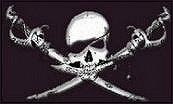
Jolly Roger -- The pirates' skull-and-crossbones flag. It was an invitation to surrender, with the implication that those who surrendered would be treated well. A red flag indicated "no quarter."
Keelhaul -- Punishment by dragging under the ship, from one side to the other. The victim of a keelhauling would be half-drowned, or worse, and lacerated by the barnacles that grew beneath the ship.
Kiss the gunner's daughter -- A punishment: to be bent over one of the ship's guns and flogged.
Lad, lass, lassie -- A way to address someone younger than you.
Landlubber or just lubber -- A non-sailor.
Letters of Marque -- Papers issued by a national government during wartime, entitling a privately owned ship to raid enemy commerce, or even attack enemy warships. Early letters of reprisal were issued to merchants to make it legal for them to counter-raid pirates! A ship bearing such letters, and operating within their limits, is a privateer rather than a pirate . . . that is, a legal combatant rather than a criminal and murderer. The problem is that letters of marque aren't always honored, even by the government that issued them. Captain Kidd had letters of marque; his own country hanged him anyway.
Lights -- Lungs. A pirate might threaten to "have someone's lights and liver."
Line -- A rope in use as part of the ship's rigging, or as a towing line. When a rope is just coiled up on deck, not yet being used for anything, it's all right to call it a rope.
Lookout -- Someone posted to keep watch on the horizon for other ships or signs of land.
Maroon -- A fairly common punishment for violation of a pirate ship's articles, or offending her crew. The victim was left on a deserted coast (or, of course, an island) with little in the way of supplies. That way, no one could say that the unlucky pirate had actually been killed by his former brethren.
Me -- A piratical way to say "my."
Me hearties -- Typical way for a pirate leader to address his crew.
Matey -- A piratical way to address someone in a cheerful, if not necessarily friendly, fashion.
On the Account -- The piratical life. A man who went "on the account" was turning pirate.
Piece of eight -- A Spanish silver coin worth one peso or 8 reales. It was sometimes literally cut into eight pieces, each worth one real.
Pirate -- A seagoing robber and murderer. Contrast with privateer.
Poop deck -- The highest deck at the aft end of a large ship. Smaller ships don't have a poop; the highest part aft is the quarterdeck.
Port -- (1) A seaport. (2) The left side of the ship when you are facing toward her prow.
Poxy, poxed -- Diseased. Used as an insult.
Privateer -- A ship bearing letters of marque (q.v.), or one of her crew, or her captain. Thus, she can only attack an enemy ship, and only in time of war, but does so as a representative of her country. A privateer is theoretically a law-abiding combatant, and entitled to be treated as an honorable prisoner if captured.
Prow -- The "nose" of the ship.
Reef -- (1) An underwater obstruction of rock or coral which can tear the bottom out of a ship. (2) To reef sails is to shorten them, tying them partially up, either to slow the ship or to keep a strong wind from putting too much strain on the masts.
Rope's end -- another term for flogging. "Ye'll meet the rope's end for that, me bucko!"
Rum (noun) -- Traditional pirate drink.
Rum (adjective) -- Strange or odd. A "rum fellow" is a peculiar person, the sort who won't say "Arrrr!" on Talk Like A Pirate Day.
Sail ho! -- "I see a ship!" The sail, of course, is the first part of a ship visible over the horizon.
Salt, old salt -- An experienced seaman.
Scuppers -- Openings along the edges of a ship's deck that allow water on deck to drain back to the sea rather than collecting in the bilges. "Scupper that!" is an expression of anger or derision: "Throw that overboard!"
Scurvy -- (1) A deficiency disease which often afflicted sailors; it was caused by lack of vitamin C. (2) A derogatory adjective suitable for use in a loud voice, as in "Ye scurvy dogs!"
Sea dog -- An experienced seaman.
Shanty -- Another spelling for "chantey" - a sea song.
Shark bait -- (1) Your foes, who are about to feed the fish (q.v.). (2) A worthless or lazy sailor; a lubber who is no use aboard ship.
Shipshape -- Well-organized, under control, finished.
Shiver me timbers! -- An expression of surprise or strong emotion.
Sink me! -- An expression of surprise.
Smartly -- Quickly. "Smartly there, men!" = "Hurry up!"
Splice the mainbrace -- To have a drink. Or, perhaps, several drinks.
Spyglass -- A telescope.
Starboard -- The right side of the ship when you are facing toward her prow.
Sutler -- A merchant in port, selling the various things that a ship needed for supplies and repairs.
Swab (noun) -- A disrespectful term for a seaman. "Man that gun, ye cowardly swabs!"
Swab (verb) -- To clean something. Being put to "swabbing the decks" would be a low-level punishment for a disobedient pirate.
Swag -- Loot.
Walk the plank -- A piratical execution. The victim, usually blindfolded or with bound hands or both, is forced to walk along a plank laid over the ship's side, to fall into the water below. Except this seems to be a total invention; it first appeared in 19th-century fiction, long after the great days of piracy.
Weigh anchor -- To haul the anchor up; more generally, to leave port.
Yo-ho-ho -- A very piratical thing to say, whether it actually means anything or not.